



to navigate to open ⌘K to toggle
    Stable Isotope Research Applications

    Stable Isotope Assays for Targeted Protein Half-Life

    We quantify muscle protein synthesis, turnover, and half-life using deuterium oxide (D₂O) and amino acid tracer methods. Our assays deliver dynamic, reproducible endpoints that help researchers understand muscle remodeling and metabolic responses with regulatory-ready precision.

    Trusted by Pharma and Biotech to Validate Mechanism of Action

    medal

    35+ Years exclusively in stable isotope tracer studies

    FILE-CHECK
    Experimental protocol designs and results delivered weeks faster than CROs
    FLASK

    GLP-compliant, CLIA-certified, 21 CFR Part 11 validated

    message-lines

    Consultative approach, with over 1,000+ studies guided from design to submission

    targeted_half_life_681x441

    Understanding Targeted Protein Half-Life

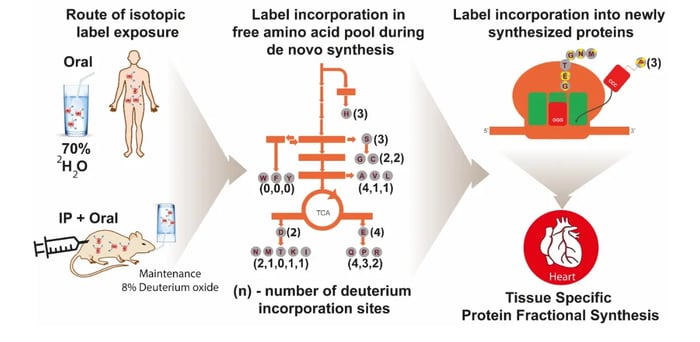
    Protein turnover reflects the balance between synthesis and degradation, and directly influences protein stability in vivo. Using D₂O as a tracer, deuterium becomes incorporated into amino acids during de novo synthesis and ultimately into newly formed proteins. As these proteins accumulate label over time, predictable isotopic patterns emerge that can be quantified by mass spectrometry.

    By analyzing how mass isotopomer distributions evolve—such as M0 depletion or enrichment plateaus—researchers can derive fractional synthesis rates, turnover rate constants, and half-lives for proteins across tissues or targeted protein classes.

    Endpoints & Readouts

    Tracer & Analytical Approaches

    Our assays provide:

    • Fractional synthesis rates (FSR)
    • Targeted protein half-lives
    • Turnover rate constants
    • Mass isotopomer distribution analysis (M0 depletion, enrichment curves)
    • Deuterium incorporation into amino acids
    • Labeling patterns in newly synthesized proteins
    • Mass spectrometry–based peptide isotopomer quantification

    These measurements deliver mechanistic insight into protein remodeling and stability.

    D₂O Metabolic Labeling for In Vivo Protein Turnover

    Flexible for preclinical and clinical research.

    Read more

    D₂O labeling enables pathway-independent incorporation of deuterium into amino acids and newly synthesized proteins. In preclinical studies, this includes small-animal dosing approaches such as oral or combined intraperitoneal (IP) + oral administration, as illustrated in standard rodent models.

    d20 labeling

    Amino Acid Label Incorporation

    Deuterium entry into the precursor pool.

    Read more

    As amino acids undergo de novo synthesis, multiple hydrogen positions can be replaced by deuterium, creating an enriched precursor pool for new protein synthesis. The number of incorporable positions varies (n), allowing sensitive isotopomer detection.

    Mass Spectrometry of Newly Synthesized Proteins

    Quantifying peptide isotopomers to model turnover.

    Read more

    Newly synthesized proteins carry measurable deuterium signatures. Mass spectrometry quantifies these peptide isotopomers, enabling modeling of incorporation curves and derivation of protein synthesis rates and half-lives.

    How Researchers Use Protein Half-Life Measurements

    The following measurements offer a dynamic, pathway-independent view of protein turnover. Our D₂O-based assays support:

    • Characterization of targeted protein stability
    • Evaluation of turnover behavior across tissues
    • Longitudinal assessment of protein remodeling
    • Mechanistic understanding of protein lifespan

    All Analyses Are Performed In Our Certified Laboratory Environment

    clia-certified 2 gold-laboratory-practice-badge 21-CFR-Part-11-Compliance-Badge 1

    Trusted by Leaders in Metabolic Research

    We weren't just sending samples and waiting for results; we were actively sitting down with the team, discussing the limitations and variability we were seeing, and working through solutions together. It felt like they were part of our internal team.

    From my experience, if sample prep changes even slightly, things can fail. When I had questions while finalizing the protocol, everyone got back to me right away. It wasn't this lag of days like with some other partners. Their detailed communication gave us confidence.

    There are academic labs that do it as well, but they’re much harder to engage and contract with.

    Looking for Answers?

    Frequently Asked Questions

    Can D₂O labeling be applied to preclinical models?

    Yes. The method is compatible with small animal studies and can support oral or combined dosing approaches.

    How is protein half-life determined?

    Half-lives are derived from isotopomer distribution modeling, including evaluation of M0 depletion or enrichment plateau behavior.

    What analytical platform is used?

    Mass spectrometry is used to quantify peptide isotopomers and model turnover kinetics.

    Are your assays GLP/CLIA compliant?

    Yes. All analyses are performed in a GLP-compliant, CLIA-certified laboratory under 21 CFR Part 11–validated workflows.

    Contact Us

    Measure Targeted Protein Half-Life With Confidence

    Our D₂O-based tracer methods provide reproducible insight into targeted protein turnover and stability. Let’s design the right protocol for your study.

    contact-background-image-femal-lab-flasks-flipped

    Metabolic Solutions, LLC.
    460 Amherst St., Nashua,
    NH 03063, USA

    Hours of Operation
    Monday – Friday
    7:30 am – 6:00 pm EST