


Stable Isotope Research Applications

Stable Isotope Assays for
De Novo Lipogenesis and Lipid Kinetics

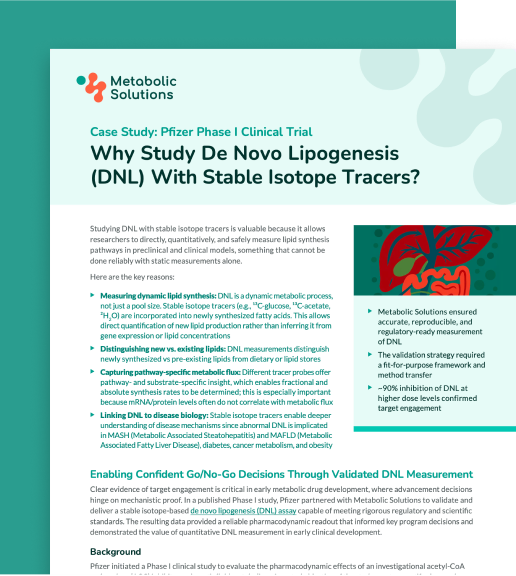
We help researchers study de novo lipogenesis and lipid kinetics using 13C and deuterium stable isotope tracer methods. Our assays provide mechanistic, regulator-trusted endpoints that link carbohydrate metabolism to lipid storage, supporting both discovery research and clinical trials.

Trusted by Pharma and Biotech to Validate Mechanism of Action

Endpoints & Readouts

What Sets Us Apart in Metabolic Biomarker Analysis

Our clients get more than data. They get clarity, confidence, and a partner built for the unique demands of drug development.

medal

35+ Years exclusively in stable isotope tracer studies

FILE-CHECK
Experimental protocol designs and results delivered weeks faster than CROs
FLASK

GLP-compliant, CLIA-certified, 21 CFR Part 11 validated

message-lines

Consultative approach, with over 1,000+ studies guided from design to submission

novo lipogeneisis_404x287

Dysregulation of de novo lipogenesis and lipid pathways is associated with obesity, diabetes, and non-alcoholic liver and cardiovascular diseases. 

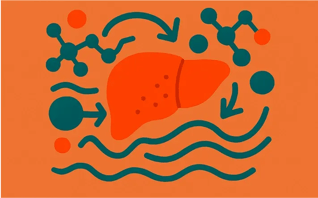
De novo lipogenesis is a tightly regulated process through which circulating carbohydrates are converted into fatty acids. The resulting lipid synthesis is believed to play a role in the development of non-alcoholic fatty liver disease and metabolic syndrome, which are often associated with insulin resistance.

Endpoints for Lipid Pathway Research

Fatty acids serve as energy substrates, while glycerol contributes to gluconeogenesis.
By tracing these fluxes, our assays provide dynamic, reproducible measures of lipid metabolism in vivo.

de-novo-lipogenesis-354x221

De Novo Lipogenesis (DNL)

Fatty acids serve as energy substrates, while glycerol contributes to gluconeogenesis.
By tracing these fluxes, our assays provide dynamic, reproducible measures of lipid metabolism in vivo. accurate quantitation of labeled glucose in plasma with as little as 25–50 µl of sample.

Lipid Kinetics-355x221

Lipid Kinetics 

Measured via 13C incorporation or through deuterium oxide labeling using Mass Isotopomer Distribution Analysis (MIDA) into plasma or hepatic triglycerides.

Our lipid analytical services include:

  • Rates of De Novo Lipogenesis (DNL)
  • Rates of lipolysis
  • Fatty acid turnover
  • Fatty acid oxidation 
  • Glycerol kinetics 

Tracer Protocols for De Novo Lipogenesis and Lipid Turnover Research

These tracer protocols show how 13C and deuterium tracers can be applied to quantify lipid synthesis, turnover, and oxidation—providing precise, in vivo measurements for research and clinical trials. 

De Novo Lipogenesis
(13C-Acetate Tracer)

Quantifies hepatic fat synthesis during carbohydrate overload using 13C-acetate and MIDA analysis.

Read more

Sodium [1-13C]acetate (10 g/day) is continuously infused after an overnight fast for 10 hours to establish hepatic 13C-acetyl CoA pools. To stimulate lipogenesis, subjects receive a high-fructose liquid diet during the infusion. Fractional DNL is calculated using Mass Isotopomer Distribution Analysis (MIDA), which applies combinatorial probability mathematics to tracer incorporation patterns.

De Novo Lipogenesis
(Deuterium Oxide Tracer)

A cost-effective alternative for measuring DNL using deuterium-labeled water and GC-IRMS.

Read more

Labeling with deuterated water is a more convenient and less costly alternative for measuring de novo lipogenesis. The basis of the technique is that deuterium oxide rapidly equilibrates with total body water. The deuterium atom labels acetyl-CoA through various enzymatic reactions in the Krebs cycle.

Gas chromatography pyrolysis isotope ratio mass spectrometry (GCP-IRMS) is used to measure very low levels of deuterium in plasma or tissue lipids. The GCP-IRMS analysis involves the separation of derivatized fatty acids and cholesterol by gas chromatography. The lipid peaks are then combusted to hydrogen gas at 1450°C, which is analyzed by isotope ratio mass spectrometry.

We can detect enrichment levels of 0.001% of deuterium with accuracy and precision. The fractional de novo lipogenesis rate is calculated from the average enrichment of deuterium in fatty acids or cholesterol.

Fatty Acid Turnover

Measures flux of circulating fatty acids using continuous infusion of 13C-palmitate.

Read more

A stable isotope labeled fatty acid, typically 13C-palmitate, is continuously infused intravenously in tracer amounts. The rate of appearance of endogenous unlabeled fatty acids into the bloodstream can be determined by calculating the dilution of infused isotopes.

Upon reaching steady-state, the rate of appearance equals the rate of disappearance or uptake. Therefore, the rate of appearance is equal to the flux or turnover rate of the substrate.

Glycerol Turnover

Directly quantifies lipolysis by tracking D₅-glycerol appearance in plasma.

Read more

The rate of appearance of glycerol is a direct index of lipolysis.
Measurement of glycerol appearance is useful since fatty acid flux underestimates the rate of lipolysis because of reesterification. Fatty acids can become reesterified within adipocytes, which prevent release of fatty acids into the bloodstream despite active lipolysis.

However, Glycerol cannot be reincorporated because adipocytes lack glycerol kinase, making it a reliable marker of lipolysis. Continuous infusion with a primed dose of D₅-glycerol rapidly achieves steady state, allowing calculation of glycerol appearance as a direct index of lipolysis.

De Novo Lipogenesis
(13C & deuterium tracers)

Assesses lipolysis and re-esterification balance using dual tracers.

Read more

Fatty acid oxidation can be measured two ways.
The rate of fatty acid oxidation can be estimated by infusing a 13C-fatty acid and measuring the rate of excretion of expired 13CO2 in the breath. The procedure requires a steady-state level of 13C-fatty acid in the bloodstream and in expired 13C-labeled carbon dioxide. Using priming doses of 13C-sodium bicarbonate before the continuous infusion of tracers will allow isotopic equilibrium by 60 minutes.

Fat metabolism can also be traced with deuterium-labeled fatty acids. Votruba et al. have validated a method using deuterated palmitate to measure dietary fat oxidation. The method involves administration of 20 mg/kg D31-palmitate in a meal. As palmitate is oxidized, each deuterium atom is lost to water. Urine or plasma can be sampled to measure the labeling in total body water.
The advantage of the deuterium label method is that no recovery factor is needed. Westerterp et al. has verified the results of Votruba and found a mean dietary fat oxidation of 16 ± 6%. This compares similarly to other published studies.
Westerterp found that dietary fat oxidation was negatively correlated with body mass index. The obese subjects had lower fat oxidation while the lean subjects had higher fat oxidation. It was hypothesized that dietary fat oxidation may play a role in human obesity.

Futile Cycling

Quantifies fat oxidation through 13CO₂ excretion in breath or deuterium labeling in body water.

Read more

The futile cycle occurs when fatty acids released via lipolysis are re-esterified within adipocytes. This cycle allows rapid adjustment of fatty acid availability to meet energy demands.
Simultaneous isotopic infusions of 13C-palmitate and D₅-glycerol quantify both lipolysis and re-esterification, providing an index of futile cycling.

Resources

Real-World Applications of Lipid Kinetics in Research and Development

Our validated lipid kinetics assays are used across metabolic research, from diabetes to exercise physiology. Below are published applications that demonstrate how tracer-based methods provide mechanistic clarity and clinically relevant endpoints.

file-pdf

Fatty Acid Oxidation
Impaired oxidation in type 2 diabetes 

Download
file-pdf

Fatty Acid Oxidation
Increased fat oxidation on a high-fat diet

Download
file-pdf

Fatty Acid Turnover
IL-6 treatment increases fatty acid turnover

Download
file-pdf

Fatty Acid Turnover
Endurance training enhances fatty acid turnover

Download
file-pdf

If you need protocol information on how to conduct lipid kinetic tracer studies, the following technical paper is available: Fatty acid metabolism measured with stable isotope tracers.


Download

All Analyses Are Performed In Our Certified Laboratory Environment

clia-certified 2 gold-laboratory-practice-badge 21-CFR-Part-11-Compliance-Badge 1

Trusted by Leaders in Metabolic Research

From discovery to submission, we’ve earned the confidence of industry innovators through precision, speed, and scientific depth.

They’ve been very consistent… the sample analysis and data has always been timely and high quality.

There are academic labs that do it as well, but they’re much harder to engage and contract with.

I think they're extremely organized, very on top of managing, sample management and all the interactions that I've had

Looking for Answers?

Frequently Asked Questions

Which stable isotope tracers are available for lipid studies?

We routinely use 13C-acetate, deuterium oxide (D₂O), [1-13C]-palmitate, and D₅-glycerol tracers. These isotopes allow precise measurement of de novo lipogenesis, fatty acid turnover, lipolysis, oxidation, and futile cycling—providing comprehensive coverage of lipid metabolism in vivo.

What makes stable isotope methods more reliable than traditional lipid biomarkers?

Traditional biomarkers measure static concentrations of lipids, which can fluctuate with diet or environment and fail to reveal underlying mechanisms. Stable isotope tracers quantify flux—how fast lipids are synthesized, turned over, or oxidized—delivering dynamic, mechanistic insights that are reproducible and regulator-trusted.

Are these tracer studies feasible in clinical trial settings?

Yes. Our protocols are designed to integrate seamlessly into clinical studies. Depending on the tracer, they may require only a single oral dose (D₂O), a brief infusion, and simple breath/blood collections. All methods are patient-friendly, repeatable, and supported with custom kits and site training for multi-center scalability.

Are your lipid kinetics assays GLP compliant?

Absolutely. All analyses are conducted in our GLP-compliant, CLIA-certified laboratories under 21 CFR Part 11 standards. This ensures full audit trails, validated SOPs, and inspection readiness—so every dataset you generate is reliable, defensible, and submission-ready.

Do regulators accept lipid kinetics endpoints?

Yes. Stable isotope tracer assays for lipid metabolism have been used as exploratory, secondary, and even primary endpoints in FDA and EMA submissions. They provide mechanistic evidence that supports go/no-go decisions and strengthens regulatory packages across metabolic disease, obesity, diabetes, and NAFLD/NASH programs.

Contact Us

Turn Lipid Pathways Into Mechanistic Clarity

Partner with our stable isotopes experts to design validated assays for de novo lipogenesis, lipid turnover, and oxidation.

contact-background-image-femal-lab-flasks-flipped

Metabolic Solutions, LLC.
460 Amherst St., Nashua,
NH 03063, USA

Hours of Operation
Monday – Friday
7:30 am – 6:00 pm EST