For many years, stable isotope research in small animals such as mice and rats was limited by sample volume requirements and destructive sampling methods. Measurements that are routine in humans and large animals—such as substrate oxidation, total body water, and energy expenditure—were unattainable in small animals without sacrificing the subjects at each time point.
Today, advances in analytical technology and isotopic techniques have changed that.
Through specialized methods developed and validated at Metabolic Solutions, researchers can now perform high-precision metabolic studies in small animals using only minute sample volumes.
These innovations open new opportunities to explore energy metabolism, substrate utilization, and disease mechanisms in preclinical models, noninvasively and longitudinally.
Measuring Substrate Oxidation in Small Animals
The Limitations of Traditional Methods
In metabolic research, one key goal is to determine how efficiently a substrate is oxidized to carbon dioxide (CO₂). Traditionally, this is achieved by administering a carbon-13 (¹³C)–labeled compound and measuring the appearance of ¹³CO₂ in expired breath over time.
While this technique is well established in humans and larger species such as dogs and horses, it has long been impractical in small animals because of their low CO₂ output and limited breath-sampling capacity.
A New Approach for Small-Animal Studies
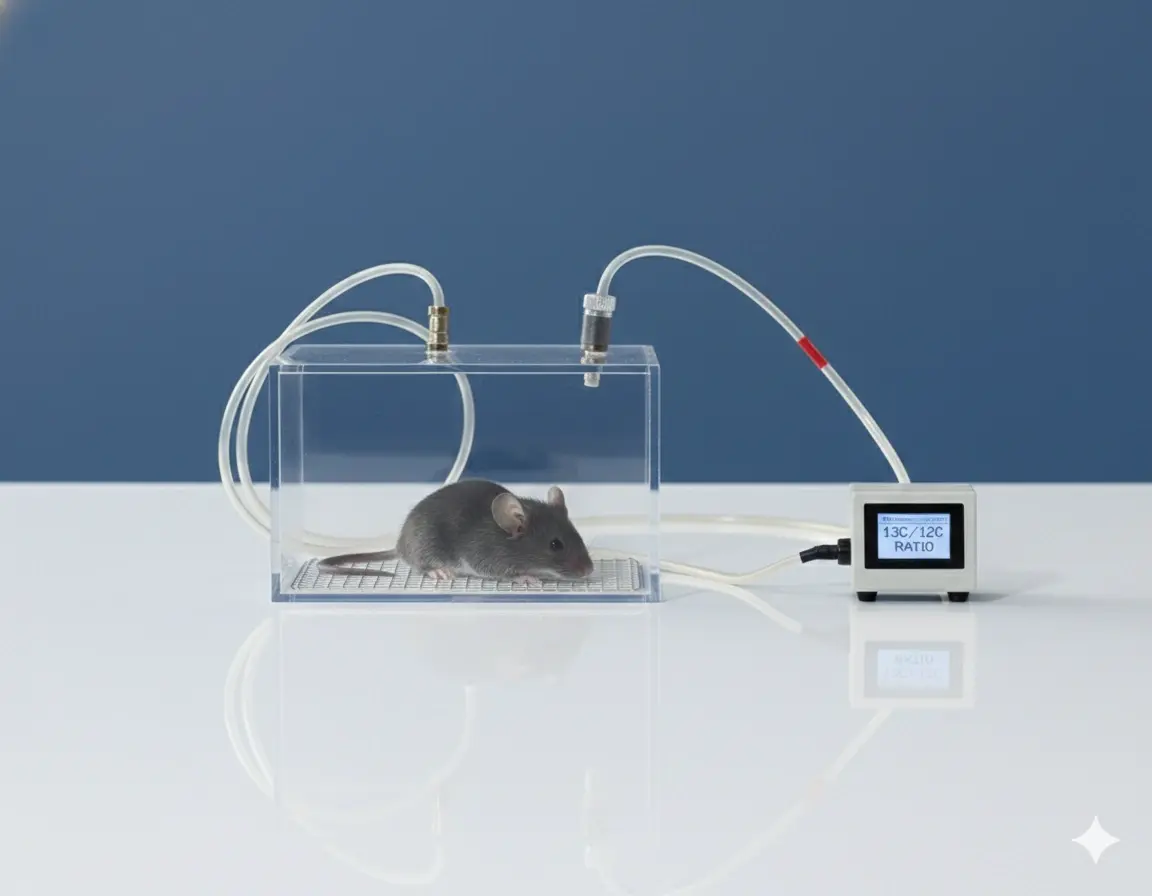
Recent technological progress has overcome this limitation. By using a small respiratory chamber equipped with a CO₂ probe and sampling a small aliquot of chamber air for stable isotope analysis, it is now possible to accurately estimate substrate oxidation in mice and other small species.
This advancement allows researchers to monitor how much of a ¹³C-labeled dose is metabolized to CO₂ in real time, without sacrificing the animal at each measurement point.
Validated in Published Research
This technique was successfully applied by Chandler and Venditti to study organic acidemia in a mouse model.
In their Molecular Therapy publication (2010), they measured the oxidation of 1-¹³C-propionate to ¹³CO₂ in conscious mice housed in a respiratory chamber. Expired gas samples were analyzed for ¹³C enrichment at Metabolic Solutions (Nashua, NH) using stable isotope ratio mass spectrometry.
This work demonstrated that breath-based ¹³CO₂ measurement is a reliable, sensitive method for assessing substrate oxidation in small-animal studies.
Determining Total Body Water and Energy Expenditure
Miniaturizing Stable-Isotope Measurements
Accurate measurement of total body water (TBW) and energy expenditure is central to understanding energy balance and metabolic health.
Traditionally, these assessments required large biological sample volumes—typically 0.5 to 1 mL—when using deuterium oxide (D₂O) and oxygen-18 (H₂¹⁸O) analysis via isotope ratio mass spectrometry (IRMS).
Such volume requirements made these measurements impossible in mice and other small species.
Metabolic Solutions’ Innovation
Metabolic Solutions has developed and validated TBW and energy-expenditure measurements using cavity ring-down spectrometry (CRDS) on biological samples as small as 15 µL.
This breakthrough enables precise isotope ratio analysis in microvolumes, allowing researchers to study energetics in small animals safely and repeatedly.
With this capability, scientists can now quantify:
- Total body water using D₂O dilution
- Energy expenditure through combined D₂O and H₂¹⁸O turnover
These assays extend the same analytical precision previously reserved for human and large-animal studies to small-animal models—without compromising accuracy or requiring large sample collections.
Why These Advances Matter
Stable isotope methodologies have long been a cornerstone of metabolic research, but their application to small animals has been technically limited.
By removing the constraints of sample size and invasive sampling, Metabolic Solutions’ validated methods now allow investigators to perform:
- Longitudinal studies of substrate utilization and oxidation
- Non-terminal assessments of total body water and energy metabolism
- Quantitative comparisons of metabolic flux between animal models and human studies
These capabilities enhance translational research—bridging the gap between preclinical findings and human metabolic insight.
Metabolic Solutions: Enabling Precision in Preclinical Metabolism
With more than 30 years of stable-isotope expertise, Metabolic Solutions continues to make advanced metabolic measurements accessible to researchers across academic, pharmaceutical, and clinical fields.
Our validated methods for small-animal isotope analysis—including substrate oxidation, total body water, and energy-expenditure measurements—provide the precision, reproducibility, and analytical rigor needed to drive discovery forward.
To learn more about our small-animal research capabilities or to discuss collaboration opportunities, contact our team.